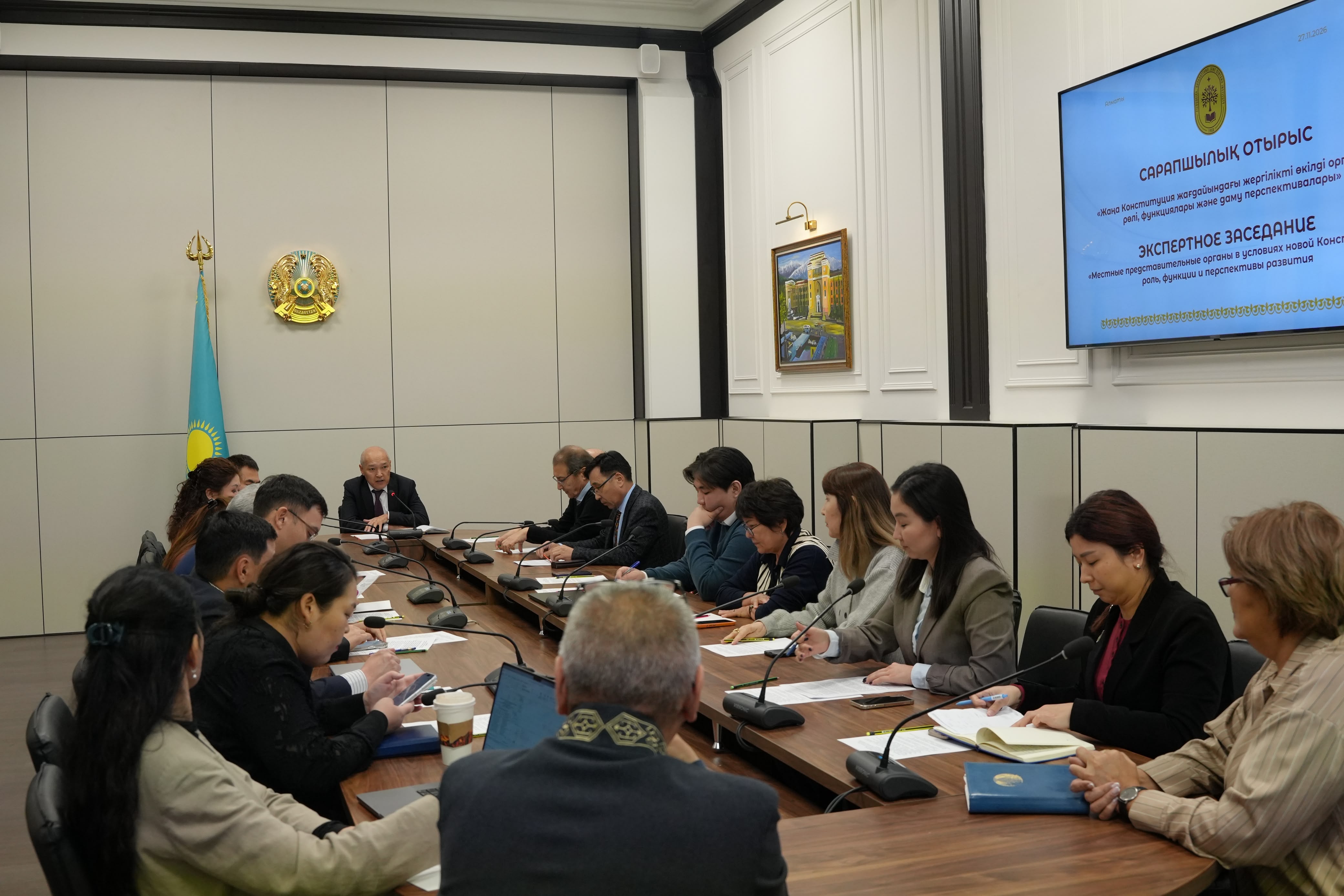
On 27 November 2026, the Institute of Philosophy, Political Science and Religious Studies (IPhPR) held an expert meeting entitled “Local Representative Bodies under the New Constitution: Role, Functions and Development Prospects.”
The discussion focused on the specific features of the current electoral system, the standalone nature of the ongoing election campaign, the renewal of representative bodies at all levels — from national to district level — and the role of maslikhats (local representative bodies) in representing regional interests and addressing citizens’ needs.
The meeting was moderated by Aidar Amrebayev, Head of the Centre for Comparative Political Studies at IPhPR. He highlighted the distinctive features of the current election campaign, emphasising its standalone nature and the importance of assessing electoral processes in terms of their practical contribution to political representation and citizen participation.
Askar Shomanov, Chief Researcher at IPhPR, focused on the institutional role of maslikhats within the local governance system.
“Maslikhats are a key institution for representing citizens’ interests at the local level. Their role extends beyond articulating public needs to ensuring a balance between representative and executive bodies,” he noted.
In this context, strengthening the autonomy of maslikhats, improving their representative and oversight functions, and enhancing deputies’ accountability for addressing issues that directly affect citizens’ lives are particularly important.
Assel Nazarbetova, Head of the Almaty Representative Office of the Kazakhstan Institute for Strategic Studies under the President of the Republic of Kazakhstan (KazISS), examined the distinctive features of the current election campaign and the renewal of local representative bodies. She highlighted growing opportunities for new participants in local politics, including young people, professionals from various sectors and civil society representatives. The renewal of elected representative bodies contributes to broader social and professional representation, bringing new expertise, experience and civic initiatives to the work of maslikhats.
Zhenisbek Tolen, Head of the Centre for Education Sciences and Social Development at the National Academy of Sciences of the Republic of Kazakhstan under the President of the Republic of Kazakhstan, highlighted the relationship between academic research, political science and socio-political practice. He emphasised the importance of understanding political changes through academic research and encouraging younger generations to engage in public life.
Zhomart Simtikov, Head of the Department of Political Science at Abai Kazakh National Pedagogical University, focused on the growing civic engagement of young people and the participation of the university community in socio-political processes.
“Today, we are seeing growing engagement among young people and their interest in socio-political processes. It is important to support this initiative and create opportunities for students to participate in public discussions, put forward their own ideas and address issues relevant to the development of society,” he emphasised.
Practical aspects of interaction between elected representatives and citizens were also discussed. These included public access to deputies, regular meetings with constituents, accountability to voters and consideration of public needs in decision-making. Such mechanisms are essential to implementing the “Listening State” concept at the local level, as they ensure continuous feedback between citizens and representative bodies.
Shynar Topayeva, Researcher at IPhPR, highlighted the role of the academic and expert community in facilitating dialogue between society and political authorities. She emphasised the importance of studying electoral processes firsthand, including candidates’ meetings with voters, their electoral platforms and their willingness to respond to public concerns.
“As young researchers, we seek to contribute to mutual understanding and dialogue between society and political authorities. We therefore not only observe election campaigns but also attend candidates’ meetings with voters, ask questions and examine their positions and electoral platforms,” she noted.
Marlen Turysbek, Researcher at IPhPR, addressed key research issues in the context of political and institutional reforms. He identified promising areas of research, including changes in local representation, the transformation of political participation and the development of mechanisms for interaction between state institutions and society. Particular importance was attached to the systematic academic analysis of ongoing reforms and their impact on the effectiveness of local governance.
During the expert discussion, participants emphasised that the renewal of representative bodies should be accompanied by improvements in their performance and stronger engagement with citizens. In this regard, maslikhats play a particularly important role as institutions closely connected to regional priorities, citizens’ everyday needs and the socio-economic development of local communities.
In conclusion, participants noted that the further development of maslikhats amid constitutional reforms depends on strengthening local representation, expanding opportunities for civic participation and improving cooperation between citizens, representative bodies and executive authorities.
The key measure of their effectiveness remains their ability to represent citizens’ interests, respond to emerging public needs and contribute to addressing specific regional challenges.