Institute of Philosophy, Political Science and Religious Studies

Institute of Philosophy, Political Science and Religious Studies

Institute of Philosophy, Political Science and Religious Studies

Institute of Philosophy, Political Science and Religious Studies

Round Table “Kazakh Philosophy in the Process of Contemporary Social Transformation”
16.09.2026
Round Table “Kazakh Philosophy in the Process of Contemporary Social Transformation”
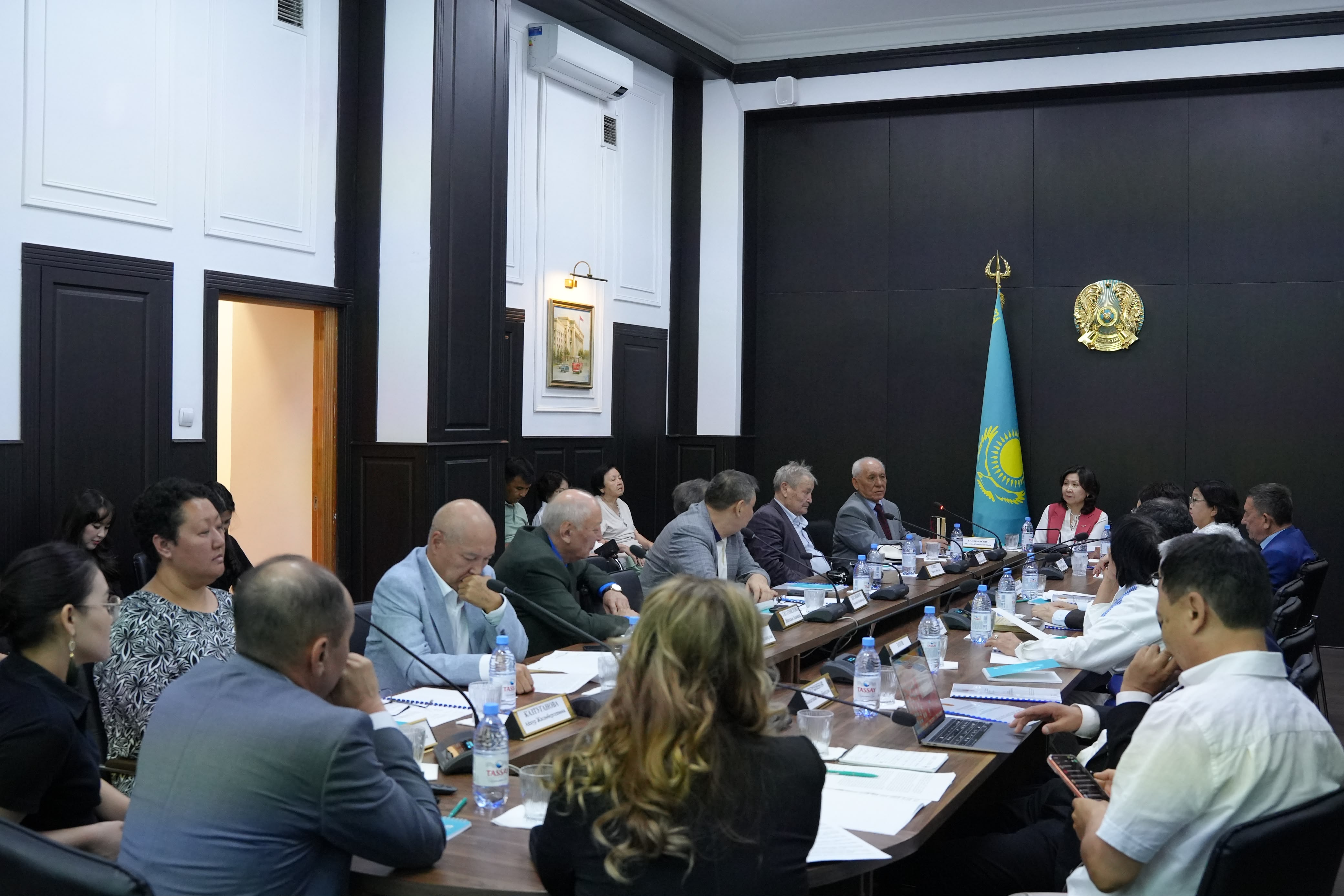
On September 16, 2026, the Institute of Philosophy, Political Science and Religious Studies held a round table on the topic “Kazakh Philosophy in the Process of Contemporary Social Transformation.”

The event was organized as part of the grant-funded project “Turkic-Kazakh Philosophical Tradition: Key Ideas and Priorities in the Process of Transformation of Contemporary Kazakhstani Society.”

The central focus of the round table was the philosophical legacy of M.S. Orynbekov, whose 80th anniversary is being commemorated this year. Participants discussed the significance of his scholarly legacy for the study of Kazakh philosophical thought, national worldview, and religious consciousness, as well as the relevance of his ideas in the context of contemporary social processes.

The participants were welcomed by Aigul Sadvokassova, Director General of the Institute.

The round table was moderated by Gauhar Barlybayeva, Chief Research Fellow of the Institute.

The event brought together leading Kazakhstani scholars and researchers in philosophy, history, religious studies, political science, and cultural studies. The main speakers included Tursyn Gabitov, Murat Abdirov, Murat Sabit, Gulzhihan Nurysha, Serik Nurmuratov, Dauletbek Rayev, Daurenbek Kussayinov, Natalia Seitakhmetova, Kairat Zatov, Nurzhan Kulumzhanov, Leskhan Askar, Bakhytzhan Satershinov, Aidar Amrebaev, Almasbek Shagyrbai, Saule Barlybayeva, Ainur Kaztuganova, and Aklima Omarova.

During the event, participants examined various aspects of the Turkic-Kazakh philosophical tradition and its significance for understanding contemporary spiritual, cultural, and social processes. Particular attention was given to the civilizational development of the Turkic world, the educational philosophy of Shokan Ualikhanov and Ybyrai Altynsarin, Kazakh ecosophy, the moral and value foundations of philosophical thought, and the distinctive features of the national worldview.

A separate series of presentations focused on the intellectual legacy of M.S. Orynbekov. Researchers examined the characteristics of religious cognition of the Kazakh people reflected in his works, the evolution of approaches to religion, and the relationship between Orynbekov’s ideas and the philosophical and religious legacy of Khoja Ahmed Yasawi.

Considerable attention was devoted to moral philosophy, including the relationship between the concepts of “Insan al-Kamil” and “Tolyq Adam,” as well as the formation of the national worldview and value orientations of contemporary society.

An important part of the discussion concerned contemporary social transformation and digitalization. Participants discussed the role of Kazakh philosophy in the digital world, the philosophical foundations of digital communication in Kazakhstan, and the importance of developing a national philosophical thesaurus in the era of artificial intelligence.

Special attention was paid to young people and the transmission of cultural and philosophical heritage to new generations. In this context, participants examined the influence of Turkic political values on the formation of young people’s political consciousness and worldview.

The round table also featured research on the philosophical meanings of traditional culture and art. Participants explored the philosophical worldview reflected in epic kuy compositions and heroic epics, as well as their artistic interpretations in Kazakh opera.

The event continued with a presentation of the monograph “The Moral Meaning of German Idealism” by renowned Kazakhstani scholar, Doctor of Philosophy, Professor Nurlan Kadyrovich Seitakhmetov. The monograph was translated into Kazakh under the title “Герман идеализмінің адамгершіліктік мәні.” The presentation continued the scholarly discussion on contemporary issues in philosophical thought, moral philosophy, and the development of philosophical culture in the state language.

The discussion demonstrated that turning to the philosophical heritage of the Turkic era, Kazakh thinkers, and representatives of the national philosophical school remains relevant in the context of contemporary social transformation. Understanding the national spiritual culture makes it possible to gain deeper insight into the values and meaning-of-life orientations of Kazakhstani society, as well as to identify opportunities for their development in the digital era.

Following the event, participants emphasized the need for further comprehensive study of the philosophical heritage of the Kazakh people and the development of scholarly research aimed at understanding its significance in Kazakhstan’s contemporary intellectual and social space.