Kazakh-French Expert Round Table Dedicated to the Day of the Republic of Kazakhstan
17.10.2025
Views: 904
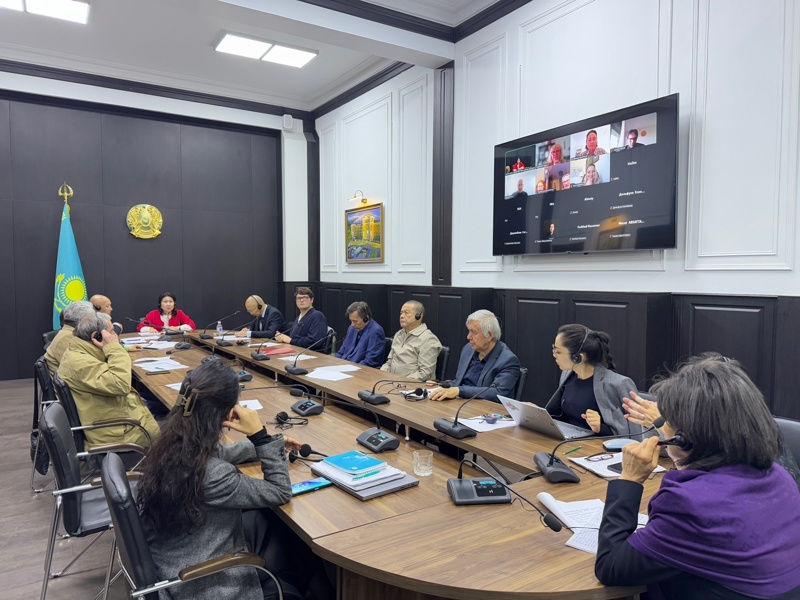
On October 17, 2025, a Kazakh-French expert round table was held on the topic “Kazakhstan — Interpreting the Meaning of the Republic Day Celebration and Historical Memory in the Digital Era. Kazakhstan–France: The Potential of Bilateral Scientific Cooperation.” The event was organized by the Center for Comparative Political Studies of the Institute of Philosophy, Political Science and Religious Studies of the Committee of Science of the Ministry of Science and Higher Education of the Republic of Kazakhstan and was dedicated to the Day of the Republic of Kazakhstan.
The purpose of the round table was to discuss modern approaches to understanding historical memory, the place and significance of national holidays in shaping state identity, as well as to develop sustainable scientific ties between Kazakhstan and France in the field of humanities and social sciences.
• Aigul Sadvokassova, Director General of the Institute, delivered the welcoming remarks. She emphasized that the participation of the French academic community in the round table clearly demonstrates the stable and progressively developing relations between the two countries. Special attention was given to the Declaration on Cooperation in Higher Education and Scientific Research, signed in December 2022 in Paris. According to this agreement, the French Institute for Central Asian Studies facilitates academic mobility for Kazakh and French researchers, creating new opportunities for deepening cooperation in the social and human sciences. It was noted that in September 2023, Kazakh language instruction began at the National Institute for Oriental Languages and Civilizations (INALCO) in Paris, and in February 2025, the Embassy of Kazakhstan in France donated educational materials on the Kazakh language, as well as literature on the history and culture of Kazakhstan, to INALCO and the National Library of Languages and Civilizations (BULAC) — initiatives aimed at expanding cultural dialogue and enhancing academic interest in Kazakhstan’s linguistic and historical heritage.
The round table was moderated by Aidar Amrebayev, Director of the Center for Comparative Political Studies. In his remarks, he highlighted the importance of fostering dialogue on historical memory, republican ideals, and civic identity, and stressed the need for deeper expert interaction between Kazakh and French research institutions.
Prominent scholars from both France and Kazakhstan presented substantial reports and reflections:
• Professor Catherine Poujol (INALCO), a specialist in the history and civilization of Central Asia, emphasized the importance of interpreting the Day of the Republic not only as a state holiday but as an academic phenomenon symbolizing choice, self-determination, and collective identity. She called for a rethinking of how humanitarian knowledge is represented.
• Professor Vera Ageeva-Grantseva (Sciences Po, Center for International Studies) analyzed Kazakhstan’s modern memory policy, focusing on its evolution since 2020 — including the centralized revision of historical narratives, the creation of new textbooks, and the development of national museums and historical cinema. She underlined the role of these processes in strengthening national identity.
• Farhad Kassenov, researcher at IPhPR, presented a report on political models of republicanism in Kazakhstan and the influence of French experience on the country’s state system. He noted that republican ideas served as an important reference during Kazakhstan’s early independence years, and elements of the French political tradition were reflected in the 1995 Constitution and the formation of a super-presidential model.
• Rustem Kadyrzhanov, Chief Researcher at IPhPR, emphasized France’s special role in the study of Central Asia within the Western academic tradition, acknowledging the significant contribution of French scholarship to understanding the region’s cultural, political, and religious dynamics.
• Bayram Balci (Sciences Po) highlighted that over thirty years of independence, Kazakhstan has not only built a strong statehood but has also become a recognized leader in the Turkic world. He focused on Kazakhstan’s cooperation with Turkey in cultural policy and historical heritage, as well as its role as a mediator in international political and economic processes.
• Adrien Faure, lecturer and researcher at the University of Paris-Saclay, discussed the importance of historical events in Kazakhstan and France as points of convergence that can form the basis for deeper academic and analytical collaboration, particularly in the fields of political transformation, historical memory, and education.
• Zhanna Karimova, Chief Researcher at KazISS under the President of Kazakhstan and Fellow at the Collegium de Lyon, described the Republic as a value-based model shaped through education, public service, and national security institutions. She also drew attention to the opportunities for bilateral academic cooperation within international platforms, including EU-funded research projects, emphasizing their openness to Kazakh scholars.
• Askar Shomanov, Chief Researcher at IPhPR, commented on the transformative impact of digital technologies on historical memory and the challenges modern societies face in preserving national narratives amid the global information environment.
During the presentation of the research conducted within the project
“Comparative Analysis of Factors Influencing the Happiness of the Population of Kazakhstan Across Regions,” Institute researcher Shyryn Tlenchiyeva presented the results of a cross-country comparison of well-being levels. She also outlined the findings of the analysis on how macroeconomic indicators affect the level of happiness in Kazakhstan, highlighting the identified general trends as well as regional differences.
In conclusion, participants unanimously noted the relevance of the topics discussed and expressed mutual interest in continuing the academic dialogue. Agreements were reached to expand cooperation through academic exchanges, joint research projects, and participation in international grant programs. It was particularly emphasized that such initiatives help build long-term ties between the research communities of both countries, contributing to the formation of a shared humanitarian space.